
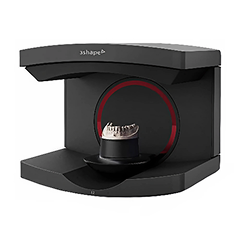
3Shape 3D Scanners
Gone are the days of biting into trays of impression material and waiting for plaster molds to set. At Doyle Orthodontics, we use 3Shape intraoral scanners to capture a precise, full-color digital model of your teeth and bite in a matter of minutes — no mess, no discomfort, no guesswork.
The 3Shape system is among the most accurate digital scanning technologies available in orthodontics today. As the wand moves across your teeth, it generates a three-dimensional model in real time that we can rotate, measure, and analyze from every angle. That model becomes the foundation for your treatment plan — and if you’re receiving clear aligners, it’s what allows us to map out your tooth movements with a level of precision that traditional impressions simply can’t match.
For patients, this means a faster, more comfortable experience at every scan appointment. For us, it means cleaner data, fewer retakes, and the ability to communicate more effectively with the labs and specialists involved in your care.
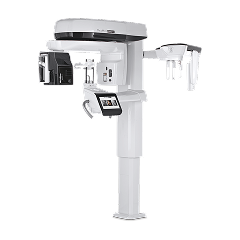
CBCT
Most orthodontic practices order a cone beam CT scan when a case is complicated. At Doyle Orthodontics, we use CBCT imaging for every patient from the very beginning — because we believe that seeing the full picture shouldn’t be reserved for difficult cases.
A traditional dental X-ray is two-dimensional. It shows teeth and basic bone structure, but it flattens a complex, three-dimensional anatomy into a single plane. CBCT imaging captures the same structures in three dimensions — teeth, roots, jawbone, TMJ joints, sinuses, and airway — giving our doctors a diagnostic foundation that would be impossible to achieve with standard radiography alone.
In practice, this matters in ways patients might not expect. We can identify impacted teeth, evaluate root positions before moving teeth, assess airway dimensions, and detect issues that might otherwise go unnoticed until they cause problems later in treatment. For patients being evaluated for orthognathic surgery or TMJ therapy, CBCT is essential. For a child getting their first orthodontic evaluation, it may reveal early developmental factors that change the entire course of treatment planning.
Using CBCT as our standard — rather than as an exception — means every patient at Doyle Orthodontics receives a diagnosis built on their complete anatomy. That’s not a marketing claim. It’s the reason other specialists refer their most complex cases here.
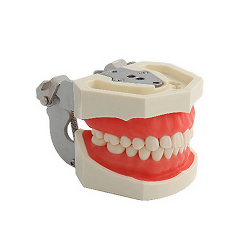
Articulated models on a jaw-motion simulator
Understanding how teeth come together is only part of the picture. Understanding how the jaw actually moves — through its full range of chewing, opening, and closing — requires something more than a static model can provide.
At Doyle Orthodontics, we use articulated models mounted on a jaw-motion simulator to analyze how the upper and lower teeth interact throughout natural jaw movement. Rather than evaluating a bite at a single point of contact, this technology allows us to study the dynamic relationship between the teeth and the temporomandibular joints (TMJ) across the full arc of jaw motion.
This level of analysis is especially important for patients with TMD or TMJ concerns, those undergoing orthognathic surgery planning, and complex cases where the final bite relationship is as important as the alignment of individual teeth. It allows us to anticipate how proposed tooth movements will affect function — not just appearance — and to make treatment decisions that account for long-term joint health.
For most orthodontists, this kind of analysis is reserved for the most involved surgical cases. At Doyle Orthodontics, it is part of how we approach care for anyone whose bite warrants a closer look.